

What Are User Research and Persona Creation?
User research and persona creation are core components of the human-centered design process, an approach that prioritizes the real needs, motivations, and behaviors of your users. Before investing in product design, branding, or development, these activities help you validate your assumptions and ensure you’re solving the right problems for the right people.
In this guide, we’ll assume you have completed the initial discovery and alignment step. Now, it’s time to deepen your understanding of your users and translate insights into actionable personas.
Start With What You Think You Know: Hypothesis Building
One of the simplest ways to begin user research is to write down every assumption you currently hold about your users. These assumptions become your hypotheses.
Example:
“I think my users shop primarily online.”
Once you’ve listed your hypotheses, challenge each one:
- Why do I think this?
- Do I have data to back it up?
Most of the time, you’ll discover gaps in your understanding, like missing data, unclear motivations, or contradictions. That’s the point. User research shines a light on these blind spots, so you can adjust your assumptions before costly missteps.
Why Testing Hypotheses Matters in Persona Development
Unchecked assumptions are dangerous. Whether you’re launching a start-up or extending a mature product line, designing around inaccurate beliefs leads to wasted time, missed opportunities, and costly rework.
Imagine assuming your user base is 40–55 years old. You design the whole product for that demographic – user experience, branding, marketing, and messaging. Only later do you discover that the actual users skew younger, or that the older audience’s needs are misaligned with your solution.
Validating assumptions early prevents:
- Misaligned features
- Ineffective marketing spend
- Poor adoption
- Incorrect pricing or sales channels
- Entirely building for the wrong segment
Testing hypotheses is foundational, not optional. Personas built on real data are dramatically more accurate, useful, and actionable.
Common Categories for User Hypotheses
As you brainstorm, your hypotheses will naturally fall into key categories. Use these to structure your thinking:
-
-
Pricing
- What do similar solutions cost?
- How much are users willing to pay?
- Is cost a major consideration or a minor concern?
-
Sales Channels
- Do users make similar purchases online, in-store, through mobile apps, or directly from sales teams?
- What influences their buying path?
-
Revenue Models
- Will your users prefer subscriptions, one-time purchases, freemium tiers, or pay-per-use?
-
Value Proposition
- Do users actually experience the problem you believe they do?
- How painful is it?
- How frequently does it occur?
-
Features
- What features matter most to them in similar products?
- What’s missing that they strongly wish to exist?
-
Translate Hypotheses Into User Interview Questions
Next, convert each hypothesis into open-ended interview questions.
Example:
Hypothesis: “Users shop primarily online.”
User question: “Tell me about the last time you purchased a similar product. Where did you shop and why?”
Open-ended questions encourage storytelling, which reveals motivations, workarounds, frustrations, and unexpected insights. Yes/no questions can still be useful for benchmarking, but they rarely uncover the rich detail needed to build accurate personas.
Don’t hesitate to refine your questions as you go. User research is iterative by design.
Who Are the “Right” Users to Interview?
Different organizations start from different vantage points:
Established products
Teams with existing customers generally know:
- User roles
- Motivations
- Pain points
- Job tasks
- Usage patterns
They can often sketch accurate personas quickly because they have years of interactions and user feedback to draw from.
New products or startups
Teams launching new products face a different challenge: they may not yet know who their true users are. They’re still making educated guesses.
In these cases, the right user is simply a starting point. You refine that definition over time through conversations, testing, and pattern recognition. Talk to as many likely users as possible, adjust your hypotheses, and repeat.
Personas for new products emerge organically and are shaped by real evidence, not assumptions.
Bringing It All Together: From Insights to Personas
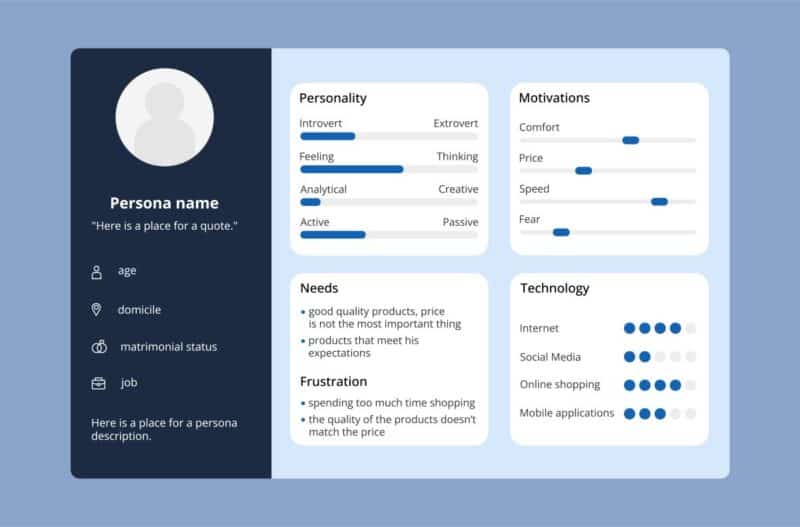
User personas serve as “character sheets” representing the archetypal users your product will serve. Effective personas include:
- Demographics (only when relevant)
- Behaviors and habits
- Motivations and goals
- Pain points
- Environment/context
- Preferred tools or platforms
- Decision-making patterns
A well-crafted persona becomes a strategic tool that guides design decisions, prioritizations, messaging, and product growth. A template could look something like this:
Finding the Right Users: A Practical and Purposeful Approach
A quick word of caution: depending on your product’s domain – whether it’s consumer gaming, specialty healthcare, or something highly niche – it can take time and creativity to find the right users to speak with. Thoughtful planning and strategic networking go a long way.
Lean on your community:
- Ask colleagues and friends for introductions
- Post calls for participants on social media
- Show up at events, meetups, or professional gatherings where your users are likely to be
- Partner with organizations, schools, associations, or online communities related to your target space
Whenever possible, aim for face-to-face interactions. In-person conversations help you pick up on non‑verbal cues like tone, hesitations, body language, expressions of excitement or frustration that bring your user’s world to life. Those moments of connection are invaluable, especially when you need to follow up later as new questions emerge.
Let Patterns Emerge and Shape Your Understanding
As you speak with more users, your understanding naturally sharpens. You’ll begin to see the real user emerge, formed by shared experiences, repeated themes, and unexpected insights. This is where rigorous notetaking, recordings (with permission), and even having a partner in the room become essential. These practices ensure you don’t miss the nuance in what users are, or are not, saying.
Through careful synthesis, you’ll identify which hypotheses hold true and which ones need to be changed or thrown out altogether. From there, you’ll form new hypotheses, test those, and continue evolving your understanding. Over time, your user becomes more than a concept. In fact, you’ll understand their motivations, struggles, goals, and decision-making patterns with clarity and confidence.
This is the point at which persona creation becomes natural rather than forced. You won’t be guessing. You’ll be describing a real, well-understood human being represented through an archetype.
When Your User Comes Into Focus
There’s something genuinely exciting about the moment when the user “comes into focus”. All the conversations, interviews, observations, and iterations suddenly click into place. You can see your user as a person with real needs, frustrations, and aspirations, rather than a demographic or an assumption.
Conducting thoughtful user research and translating what you learn into detailed personas gives your product team a strong foundation. It grounds your application design and development decisions in reality rather than in theory. And perhaps most importantly, those interviews and insights become fertile ground for creativity. As you move into brainstorming and solutioning, you’ll find yourself returning to these user stories again and again. They’ll guide your choices, spark ideas, and help your product resonate in ways that assumptions alone never could.
Final Thoughts
User research and persona creation aren’t just early-stage tasks; they’re ongoing practices that ensure your product remains aligned with the evolving needs of your audience. By rigorously testing assumptions, asking the right questions, and engaging real users, you lay the groundwork for products that resonate, convert, and stand out.